
· OhMyVan Team · Batteries · 12 min read
How Long Will a 100Ah Battery Last in a Van?
A 100Ah LiFePO4 battery gives 1024 Wh of usable energy in the OhMyVan calculator, enough for 2.49 days of a 45 W van fridge. Here are four real load lists, the battery the calculator recommends for each, and the MPPT, main fuse and cable that refill it.

- battery
- lifepo4
- sizing
- explainer
- rv
Battery capacity looks simple until you ask how long it actually lasts. A 12 V 100 Ah LiFePO4 battery gives about 1 kWh of usable energy, which runs a 45 W compressor fridge at 378 Wh a day for about 2.5 days. The same battery does not cover a fridge with a laptop and lights for a full day, because that list needs 106.01 Ah and our calculator recommends a 150 Ah battery instead. Runtime is a load question first and a battery label question second, and our calculator answers it with your actual appliances rather than one generic chart.
See our safety notes for details.
What does 100 Ah mean for a 12 V van battery?
Amp-hours describe charge, so the voltage has to come first before the number turns into useful energy. The calculator starts from the 100 Ah rating, applies an 80% depth of discharge to get 1024 Wh of usable energy, and then applies a 92% round-trip efficiency when it converts that energy into days of runtime. Charging and discharging a lithium bank is not lossless, and the calculator keeps those two losses separate instead of hiding them in one discount factor.
Those assumptions explain why the label and the usable reserve are two different numbers. The calculator also rounds the required capacity up to a standard battery size, which is why you see 100 Ah, 150 Ah or 200 Ah in the output instead of a fractional number. You can put your own load list into the RV battery amp-hour calculator and watch the recommended bank change as you add appliances.
How long will a 100Ah battery run a 12V fridge?
For a 45 W fridge that runs 24 hours at a 35% duty cycle, the calculator puts daily energy at 378 Wh and gives 2.49 days of runtime on the 100 Ah battery. The duty cycle is doing most of the work here, because the compressor cycles on and off rather than pulling 45 W all day. A fridge that sits in a hot van, gets opened constantly or holds warm food will run a higher duty cycle, and the calculator will answer with more daily energy.
For a two-day reserve the calculator requires 80.25 Ah, which rounds up to the 100 Ah recommendation. The same calculator output gives 1024 Wh of usable energy, so the runtime number and the recommended size come from one calculation rather than two rules of thumb. Here is how four common van load lists compare in the same 12 V LiFePO4 plan.
| Load list | Daily energy | Battery required | Recommended battery |
|---|---|---|---|
| Fridge only | 378 Wh | 80.25 Ah | 100 Ah |
| Fridge, light, laptop, two phones | 726 Wh | 106.01 Ah | 150 Ah |
| Fridge and Starlink | 1578 Wh | 167.5 Ah | 200 Ah |
| Fridge and diesel heater | 618 Wh | 65.6 Ah | 100 Ah |

What changes when you add lights, a laptop and phones?
Those small loads stop being small once an inverter is in the path. The calculator totals 726 Wh for the fridge at 378 Wh, one LED light at 48 Wh, a laptop at 240 Wh and two phones at 60 Wh, and its DC-side equivalent for that day is 998.73 Wh. That plan needs 106.01 Ah, so the calculator recommends a 150 Ah battery and the gear list offers the next standard size, a 200 Ah unit.
The inverter itself is sized at 300 W, with 32.47 A of DC draw at full load. The inverter branch fuse is a 50 A Class T unit at the positive busbar, and the inverter branch cable is 8 AWG with 70 A ampacity on a 3 ft run, where the calculator puts the drop at 1.21%. That is the branch role, not the battery main role, and the two numbers must not be swapped when you buy parts.
A 100 Ah battery can still run this list, but it will not stretch to a full day of autonomy on paper. If you want the laptop and lights without giving up reserve, the honest answer is a larger bank rather than a smaller inverter.
How long will a 100Ah battery last with Starlink?
Starlink is the load that breaks the 100 Ah plan. At 50 W for 24 hours it adds 1200 Wh, which puts the daily total at 1578 Wh and the required bank at 167.5 Ah. The calculator recommends a 200 Ah battery, and that bank runs the fridge and the dish for 1.19 days.
The solar side grows with it. This setup asks for a 350 W array, built as four 100 W panels, with a 40 A MPPT controller. If you work from the van every day, the battery and the roof have to be sized together, because a 100 Ah battery that is empty by noon is not a cheaper plan.
Does a diesel heater shorten the runtime?
On a 100 Ah battery, a fridge plus a diesel heater at 30 W for 8 hours comes to 618 Wh a day, and the calculator gives 1.52 days of runtime. The heater adds 240 Wh to the day, which is less than the fridge alone, so the runtime stays respectable. The charging problem is what changes in winter, not the battery math.
Seattle in November through January has a worst-month peak sun value of 0.8522 hours, and the calculator needs 966.91 W of panels to cover that 618 Wh day. That is above the 800 W roof allowance, so the calculator caps the array at 800 W and reports a shortfall of 106.68 Wh a day. A winter trip in a grey climate needs DC-DC charging from the alternator or shore power beyond the roof, and a LiFePO4 battery that sits below freezing needs a heater or a BMS that blocks charging until the cells warm up.
How much solar does it take to refill a 100Ah battery?
Denver in June through August gives 6.31 peak sun hours, and the fridge load needs 79.86 W of panels, which the calculator rounds to 100 W. That array harvests 473.31 Wh a day against 378 Wh of use, and the charge current is 6.94 A, so the calculator chooses a 10 A MPPT controller. The full summer setup is prefilled in the RV solar calculator.
In December through February the same location gives 2.29 peak sun hours, and the requirement rises to 220.15 W, rounded to 250 W and built as three 100 W panels. The charge current is 20.83 A, the calculator recommends a 30 A MPPT, and the estimated harvest is 429.26 Wh a day. That is the same fridge and the same 100 Ah battery, and the panel count tripled because the sun did not.
The diagram below shows how the winter array, MPPT and charge fuse connect to the battery.
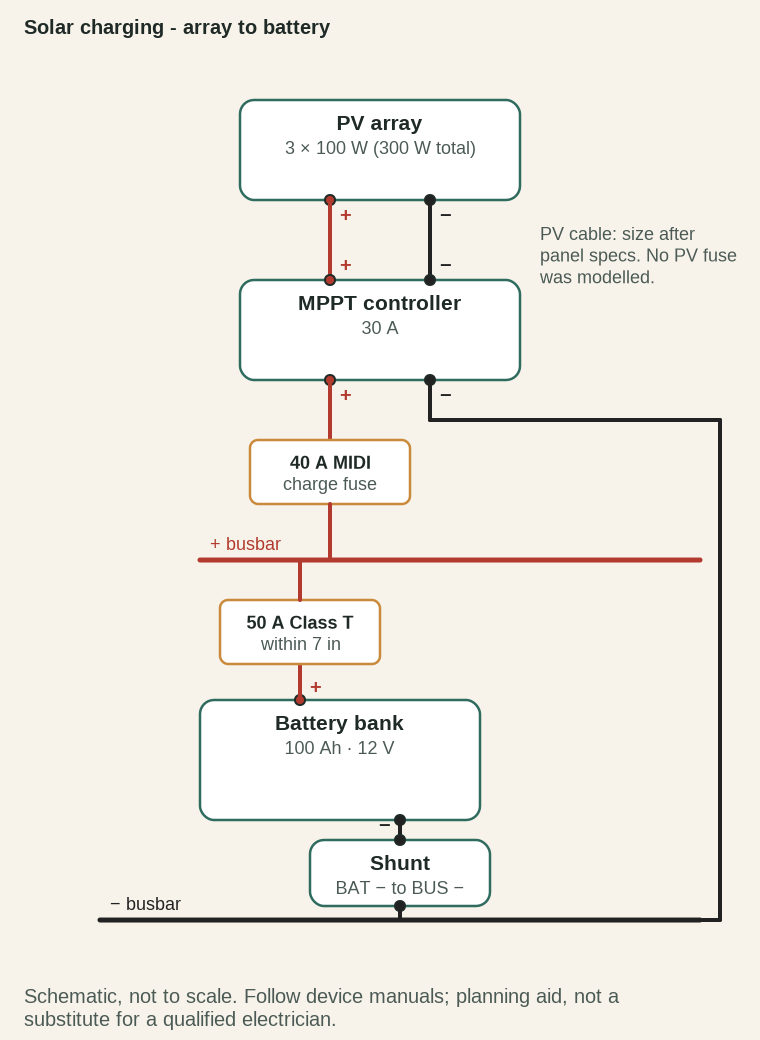
The diagram shows three 100 W panels, a 30 A MPPT, a 40 A MIDI charge fuse, an 8 AWG battery main cable with a 50 A Class T main fuse, and a 100 Ah LiFePO4 battery.
London needs 120.41 W in summer and 761.44 W in winter, so the 800 W roof is the ceiling with 397.14 Wh a day. That is a thin winter reserve, so plan alternator DC-DC or shore power for a UK trip.
Which fuse and cable does the 100Ah plan need?
The battery main fuse is a 50 A Class T fuse within 7 in / 18 cm of the battery, and the battery main cable is 8 AWG with 70 A ampacity on a 2 ft run, where the calculator puts the drop at 0.13 V and 1.09%. The main fuse protects the main cable and covers the whole bank, so it is sized from total discharge and total charge together.
For the full workday list the main fuse covers 38.88 A of discharge and 30 A of charge, takes the larger design current, and requires 48.61 A. The Class T cartridge carries a 20 kA interrupt rating, which is why the calculator uses it here instead of a blade fuse at the battery post. A Class T main fuse belongs within that 7 in / 18 cm window so the cable run is protected before it disappears into the van.
The branch fuses are separate parts of the same plan. In the fridge-only version the charge path uses a 30 A MIDI fuse, and the DC fuse block feed uses another 30 A MIDI fuse. Add the laptop and the array grows, so the charge fuse moves to 40 A MIDI in the workday plan. Both sit at the positive busbar, away from the battery post and its main fuse.
Every fuse protects the cable it sits on, so a fuse never goes above the ampacity of that cable. If an inverter or a fuse holder manual asks for a different value, the manual wins and the cable has to be rated for the fuse the manual names. The calculator numbers give you a complete starting plan, and a qualified electrician checks the finished installation.
The diagram below shows the main fuse, the branch fuse and the DC fuse block feed around the battery.
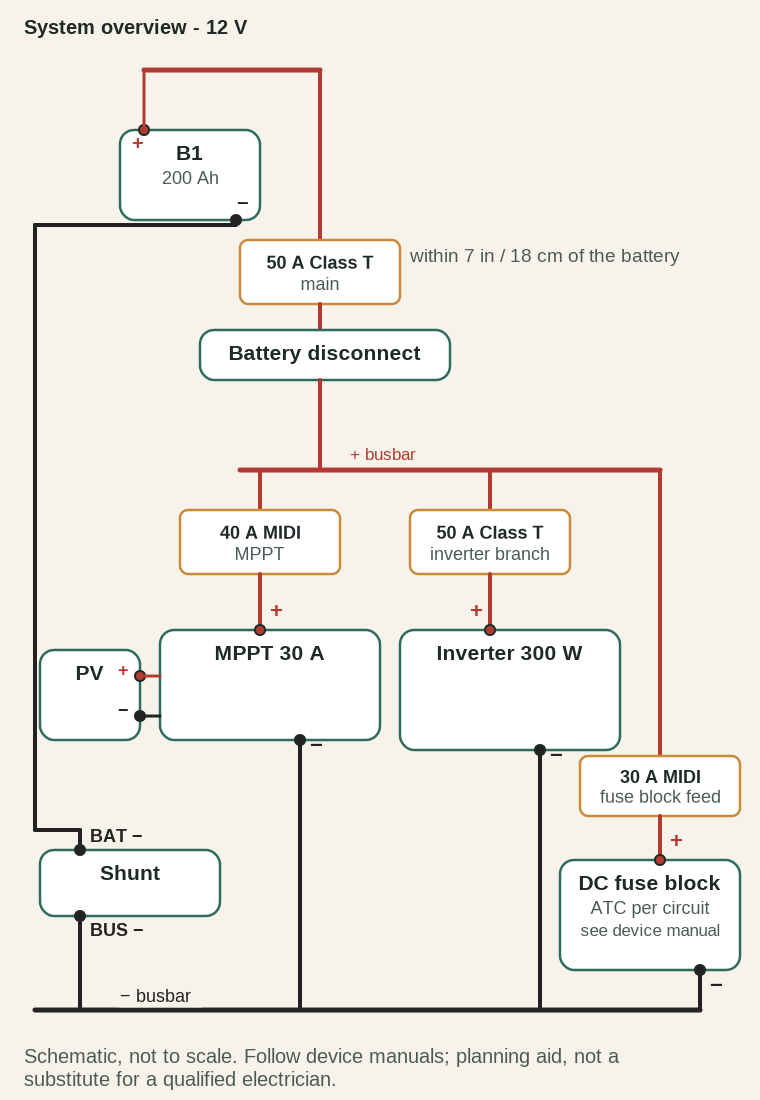
The diagram shows the 200 Ah gear-list battery, a 40 A MIDI charge fuse, a 30 A MPPT controller, a 300 W inverter and a 30 A MIDI fuse block feed, plus a 50 A Class T main fuse within 7 in of the battery and a 50 A Class T inverter branch fuse at the positive busbar.
When is a 100Ah battery the wrong buy?
A 100 Ah battery is a good fit for a fridge, some lights, phones and a small inverter. It stops fitting as soon as the load list grows into a workday or a winter routine, and the calculator shows exactly where each line falls.
- A fridge, lights, a laptop and two phones need 106.01 Ah for one day, so the calculator moves to a 150 Ah battery.
- A fridge plus Starlink needs 167.5 Ah, so the calculator moves to a 200 Ah battery and a 350 W array.
- A winter diesel heater plan in Seattle leaves a 106.68 Wh daily shortfall even with an 800 W roof array.
If your list looks like any of those, buy the battery the calculator recommends and plan the roof space at the same time. A second 100 Ah battery in parallel needs its own fuse on each battery positive, and only matched batteries of the same chemistry and similar age should share a bank, so the battery calculator is the place to test that layout before you buy.
Which battery, MPPT and fuse fit this plan?
The gear list turns the same setup into shopping categories with the web tag already applied. For the fridge plan it asks for a 100 Ah 12 V LiFePO4 battery, a 10 A MPPT controller, a 100 W solar panel, a 50 A Class T main fuse and an 8 AWG battery main cable. Those are the exact parts the calculator sized, so a different panel or controller changes the numbers and needs a fresh run.
- 100 Ah 12 V LiFePO4 battery
- 10 A MPPT solar charge controller
- 100 W solar panel
- 50 A Class T main fuse
- 8 AWG battery main cable
The app uses the same calculator with the full wiring list when you want to compare a shop quote. More battery guides live in the Batteries category hub, and two related posts walk through the fridge solar plan and the 2000 W inverter wire size.
Frequently asked questions
How long will a 100Ah battery last in a van?
A 100 Ah LiFePO4 battery gives 1024 Wh of usable energy and runs a 45 W fridge for 2.49 days in the calculator. Adding a laptop, lights and phones pushes the daily load to 726 Wh, and after inverter losses the bank needs 106.01 Ah, so the calculator recommends a 150 Ah battery for that list.
How long will a 100Ah battery run a 12V fridge?
The calculator gives 2.49 days for a 45 W fridge at a 35% duty cycle, which is 378 Wh a day. A hotter van, a fuller fridge or a higher duty cycle shortens that number, so set the duty cycle in the calculator to match how you actually travel.
Can a 100Ah battery run a fridge and a laptop?
It can run them, but not for a full day of planned autonomy. The combined list needs 106.01 Ah and the calculator recommends a 150 Ah battery, so a 100 Ah bank covers less than the full day that list uses.
Will a 100Ah battery run Starlink?
Starlink at 50 W for 24 hours adds 1200 Wh, which brings the daily total to 1578 Wh. The calculator needs 167.5 Ah and recommends a 200 Ah battery, so a 100 Ah bank is not a sensible match for full-time Starlink use.
Does a 100Ah battery need a main fuse?
Yes, and the calculator sizes the main fuse at 50 A Class T for this plan. The main fuse covers the whole bank, while the inverter branch and the charge path get their own fuses at the positive busbar.
How much solar does it take to charge a 100Ah battery?
One 100 W panel covers a 45 W fridge in a Denver summer, and three 100 W panels cover the same load in winter, where the calculator recommends 250 W. The MPPT moves from 10 A to 30 A with the larger winter array.