
· OhMyVan Team · Solar · 11 min read
Solar Panel Series vs Parallel for a Van
Two panels make the same watts in series or parallel, but they hand the controller a different voltage and current. This walk-through uses a real 12 V van load to show which layout fits your roof.

- solar-panel
- mppt
- cable
- explainer
- sizing
Two panels that add up to the same wattage can still behave very differently once a roof vent throws a shadow across one of them. Series wiring and parallel wiring both carry the array’s power down to the charge controller, but they arrive at different voltage and current, and that changes which controller has the headroom, how thick the roof cable needs to be, and which parts of the array need their own fuse. This walk-through starts from a van that uses 1056 Wh a day and shows what each layout asks of the rest of the system.
See our safety notes for details.
What changes when you wire panels in series or in parallel?
Series wiring links the positive of one panel to the negative of the next, so the panel voltages add up while the current stays at the level of a single panel. Parallel wiring ties every positive together and every negative together, so the currents add up while the voltage stays near the level of one panel. Either way the array’s wattage is the same, which is why the total output on a clear roof does not settle the choice for you.
| What it does | Series | Parallel |
|---|---|---|
| Voltage at the controller | Adds across the string | Stays near one panel |
| Current at the controller | One panel’s current | Adds across the panels |
| Roof cable for the same watts | Thinner for the same run | Thicker for the summed current |
| Partial shade on one panel | Pulls the whole string down | Limits the damage to one branch |
| Controller limit that bites first | Maximum PV voltage | Maximum PV current |
| Fusing | One string, one disconnect | Three or more strings need a fuse each |
How many panels does this van need before wiring matters?
The example van carries a 45 W compressor fridge, a laptop, a router, an LED light, two phones and a fan. Those loads add up to 816 Wh of DC energy and 240 Wh of AC energy, or 1056 Wh a day. A 300 W pure sine inverter covers the AC side with a 32.47 A DC draw, and the battery needs 282.08 Ah, which the calculator rounds to a 300 Ah LiFePO4 bank.
The array size swings with the sun before the wiring question even starts. Denver in June through August has a peak sun value of 6.31 hours, so the calculator needs 280.73 W and recommends 300 W as three 100 W panels. Denver in December through February drops to 2.29 hours, so the same load needs 773.84 W and the bank becomes four 200 W panels for 800 W. London in June through August sits at 4.19 hours, where the calculator needs 423.27 W and recommends 450 W, met by three 200 W panels for 600 W. London in December through February is the hard case: 0.66 hours would need 2676.59 W, so the roof tops out at 800 W and the harvest falls to 397.14 Wh a day against 1056 Wh of use.
| Roof case | Peak sun hours | Array the calculator selects | Harvest | Daily use |
|---|---|---|---|---|
| Denver summer | 6.31 | 3 × 100 W (300 W) | 1419.93 Wh | 1056 Wh |
| Denver winter | 2.29 | 4 × 200 W (800 W) | 1373.64 Wh | 1056 Wh |
| London summer | 4.19 | 3 × 200 W (600 W) | 1412.64 Wh | 1056 Wh |
| London winter | 0.66 | 4 × 200 W (800 W, roof cap) | 397.14 Wh | 1056 Wh |
Those arrays are what the controller has to manage, and the series or parallel question only makes sense once the wattage is settled. The full winter case is already filled into the RV solar calculator, and the battery side is in the battery calculator.
The diagram below shows the winter charging path from four 200 W panels through the controller and its charge fuse to the 300 Ah battery, with the battery main fuse at the far end.
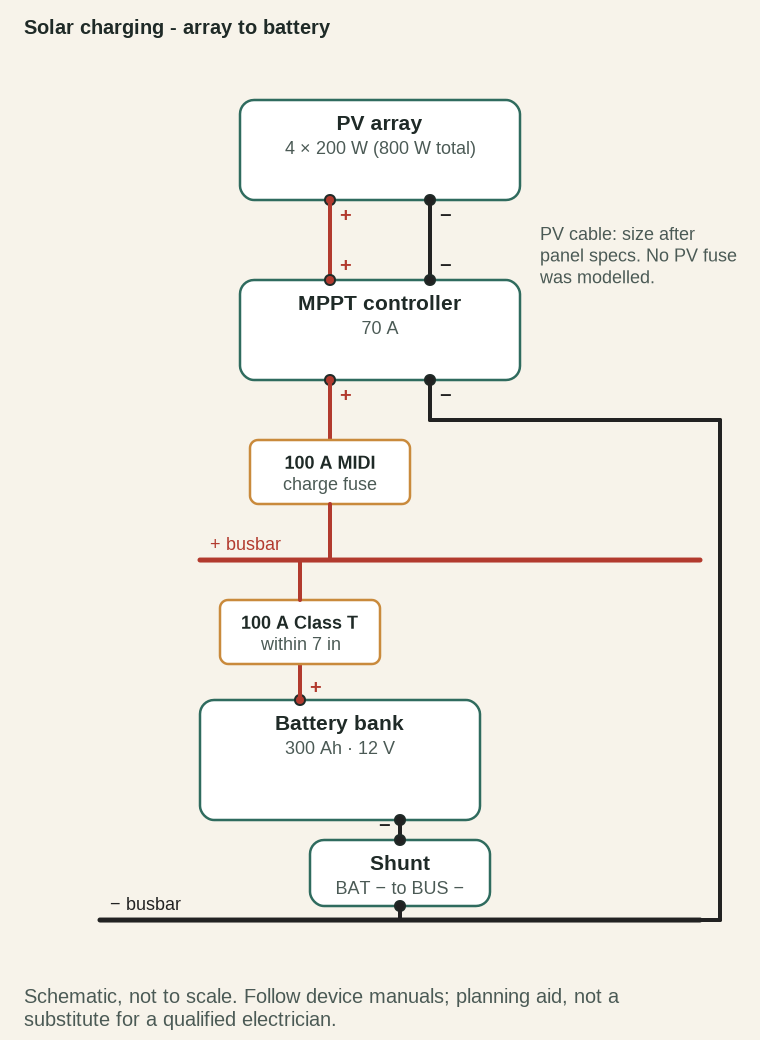
The winter charging path runs from four 200 W panels through the 70 A MPPT and its 100 A MIDI charge fuse to the 300 Ah 12 V battery, with the 100 A Class T main fuse within 7 in of the battery.
Does the layout change the charge controller size?
The controller size follows the array wattage and the battery’s charge voltage, not the way the panels are joined. For the 300 W summer array the calculator gives a 20.83 A charge current, a 26.04 A required rating and a 30 A MPPT. The 600 W London summer array gives 41.67 A of charging, 52.08 A required and a 60 A controller. The 800 W winter array gives 55.56 A of charging, 69.44 A required and a 70 A controller. Wire the same array in series or in parallel and those charge-side numbers stay where they are.
What the layout does change is the PV side that the controller sees. A series string multiplies the panel voltage, so the controller’s maximum PV input voltage becomes the hard ceiling, and cold mornings push that voltage higher than the label on the panel suggests. A parallel array keeps the voltage low and multiplies the current, so the controller’s maximum PV input current becomes the limit. The gear line for the 70 A unit says it plainly: choose a controller rated above your cold open-circuit voltage.
Series voltage also decides whether the array disconnect is rated high enough, because that switch has to handle the string voltage rather than the system voltage. Neither number replaces the panel datasheet check, and the controller manual outranks any general rule on the roof.
How do you fuse a parallel array and a series array?
A single series string is one circuit, so it needs the array disconnect and no per-string fuse. A parallel array with three or more strings needs a fuse on each string positive, sized from the panel’s maximum series fuse rating. Two parallel strings usually skip the string fuse, but you still read the panel label before you trust that shortcut. This is the part that decides how many fuse holders live on the roof.
Down at the battery the calculator puts a fuse on every positive feed. The MPPT charge fuse protects the controller’s positive cable where it joins the battery-side busbar and follows the controller current: 40 A MIDI for the 30 A controller on 10 AWG cable rated 55 A, 80 A MIDI for the 60 A controller on 6 AWG rated 100 A, and 100 A MIDI for the 70 A controller on 4 AWG rated 135 A. The battery main fuse is a different part with a different job. It protects the battery cable and covers total discharge plus total charge, so it lands at 60 A Class T for the summer plan, 80 A for the London summer plan, 100 A for the winter plan, and 125 A once a 30 A DC-DC charger joins the winter plan. That last case pushes 100 A of charge current into the battery, so the battery BMS must be rated for 100 A of continuous charge, and a lower-rated BMS is not enough even with the larger cable. The cable follows the fuse: 100 A × 1.25 gives the 125 A Class T, the cable ampacity has to be at least that fuse divided by 0.85, and on the ABYC table for 90 °C single-conductor cable in 30 °C air only 2 AWG at 180 A clears it, so the 6 AWG at 100 A and the 4 AWG at 135 A that suit the smaller plans are too small here. Those table values assume the cable is out of a hot engine space and not bundled with other cables; in a hot run or a bundle the same size carries less, so the 180 A does not apply there and the cable has to be sized for the derated value. It mounts within 7 in / 18 cm of the battery positive.
The roof cable from the panels is sized from the panel datasheet numbers rather than from the controller rating, so that line stays open until the panels are chosen. If your controller or panel manual asks for a larger fuse or cable than the plan shows, the manual wins and the cable has to be rated for that fuse. The safety page explains why the main fuse belongs at the battery rather than at the busbar.
What does shade really do to a series array and a parallel array?
Partial shade is the honest reason to pick parallel. In a series string the current is set by the weakest panel, so a shadow across one panel drags the whole string toward that panel’s output. In a parallel array the sunlit branches keep working, so a tree or a roof box costs you less. Bypass diodes soften the series case, and an MPPT controller keeps hunting for the best operating point, so the real difference is smaller than the scare stories suggest.
Diffuse cloud is a different problem. Parallel wiring does not create sun on a grey day, and both layouts lose most of their output together. The London winter case shows the size of that loss: the 800 W roof harvests 397.14 Wh a day against 1056 Wh of use, and the calculator reports a daily shortfall of 931.59 Wh. That gap is why the plan needs a second charging source. A 30 A DC-DC charger adds 460.8 Wh a day, or 36 Ah, on a drive, and shore power covers what is left on the longest grey stretches. If the battery sits below 0 °C, LiFePO4 charging needs a heater or a BMS that blocks charge until the cells warm up.
Which layout fits which van roof?
The right answer depends on what the roof looks like at three in the afternoon, not on a slogan.
- An open roof with no daily shade and a long run to the controller suits one series string, as long as the cold open-circuit voltage stays under the controller limit.
- Daily shade from a vent, an aerial or a tree suits parallel branches, because the sunlit panels keep producing.
- Three or more parallel strings need the per-string fuses, so budget the holders and the roof space for them.
- A mixed roof often lands on two panels in series joined in parallel with a second pair, which keeps some shade tolerance without doubling the roof current.
A small or large van changes only the roof cap, never the fuse logic. The calculator capped this large van at 800 W, and the winter plan already sits on that limit.
What should you check before you buy?
Start from the array the calculator selects, then read the panel label for open-circuit voltage, maximum power current and the maximum series fuse rating. The MPPT controller guide covers the voltage ceilings that decide a series string, and the fridge panel walk-through shows the same method for a smaller load. When the wattage is settled, the gear list for this plan points at suitable 200 W panels, a 70 A MPPT and a 300 Ah LiFePO4 battery. More planning notes sit on the Solar category hub.
Frequently asked questions
Does series or parallel wiring give more power?
Neither layout changes the array’s wattage on a clear roof, so the total power stays the same. What changes is the voltage and current that reach the controller, and that difference decides which controller fits and how thick the roof cable needs to be.
Is parallel wiring always better in shade?
Parallel wiring helps when part of the array is shaded while the rest stays in sun, because the lit branches keep producing. It does nothing for a fully overcast sky, and a series string with bypass diodes can still deliver useful power, so the honest answer depends on the shadow pattern.
Can I mix series and parallel on one van roof?
You can join two panels in series and then put that pair in parallel with a second pair, which is often called a two-series two-parallel layout. Keep the strings matched in panel count and model, and add the per-string fuses once you have three or more parallel strings.
Do parallel solar panels need fuses?
A parallel array with three or more strings needs a fuse on each string positive, sized from the panel’s maximum series fuse rating. Two parallel strings usually skip the string fuse, but the panel label and the local code still decide that, so check both before you wire.
How do I size the charge controller for either layout?
Take the array wattage, divide by the battery charge voltage, and add the calculator’s design margin; the calculator does that for you and returns the standard size. The 300 W, 600 W and 800 W arrays in this plan land on 30 A, 60 A and 70 A controllers, and the layout does not move that number.