
· OhMyVan Team · Solar · 11 min read
How Much Solar to Run an RV Air Conditioner
A 1500 W rooftop air conditioner plus a small fridge uses 6378 Wh a day. The calculator sizes a 1200 W roof, a 400 Ah bank and the 150 A fuse the inverter branch needs.
- air-conditioner
- solar-panel
- how-many
- inverter
- rv
An RV air conditioner is the load that decides whether a solar plan works. A 1500 W rooftop unit running 4 hours a day uses 6000 Wh, and with a 45 W compressor fridge on the same bank the daily total reaches 6378 Wh. The calculator caps the roof at 1200 W on a large RV, and that array harvests 5679.72 Wh on a Denver summer day, so the honest answer is a partial yes in summer and a clear no in winter.
That honesty is the point of this guide. The ranking pages hand you a watt range and a shop link, but a range doesn’t tell you whether the array fits the roof or whether the battery survives the night. Here’s what the numbers look like when the same load runs through our calculator in two countries and two seasons, followed by the battery, the power inverter, the fuse and the cable that the plan actually needs.
See our safety notes for details.
What does an RV air conditioner use in a day?
The calculator starts with a 1500 W rooftop air conditioner running 4 hours, which comes to 6000 Wh of AC energy. It adds the 45 W compressor fridge at 378 Wh, so the DC and AC loads together reach 6378 Wh per day. The power inverter doesn’t run for free, because the calculator adds 818.18 Wh of conversion loss and 240 Wh of idle draw, which lifts the DC-equivalent energy to 7436.18 Wh. Every panel and battery number after this point sits on that figure.

The load list is editable in our battery amp-hour calculator, where you can change the AC hours or add lights, a laptop or Starlink. Four hours of cooling is a reasonable planning number for a hot afternoon, and a longer runtime raises every size in the plan.
How much solar does a 1500 W air conditioner need?
The solar requirement follows the daily energy, the travel months and the location. A 24 V system keeps the inverter DC current sane on a load this size, so the plan below is built at 24 V. In Denver from June through August the calculator requires 1571.1 W of panels, but a large RV roof caps the array at 1200 W, so it selects six 200 W panels. That 1200 W harvests 5679.72 Wh per day against 7436.18 Wh of DC-equivalent use, a shortfall of 1756.46 Wh.
London changes the summer answer in a way Denver doesn’t. In London from June through August the same load requires 2368.81 W and the capped array harvests 3767.04 Wh, a shortfall of 3669.14 Wh. The table collects the four seasons so you can see the spread instead of one annual average.
| Location and season | Peak sun hours | Panels required | Roof-capped array | Harvest per day | Shortfall per day |
|---|---|---|---|---|---|
| Denver summer | 6.31 | 1571.1 W | 1200 W | 5679.72 Wh | 1756.46 Wh |
| Denver winter | 2.29 | 4330.79 W | 1200 W | 2060.46 Wh | 5375.72 Wh |
| London summer | 4.19 | 2368.81 W | 1200 W | 3767.04 Wh | 3669.14 Wh |
| London winter | 0.66 | 14979.47 W | 1200 W | 595.71 Wh | 6840.47 Wh |
You can open the prefilled RV solar calculator and move the location or the months to watch the array requirement climb.
Why does the same air conditioner need more panels in winter?
The peak sun hours do the damage, not the air conditioner. Denver’s worst summer month gives 6.31 peak sun hours against 2.29 in the worst winter month, and London is lower in both seasons, at 4.19 in summer and 0.66 in winter. The same 7436.18 Wh then has to come from a fraction of the sunlight, so the calculator requires 4330.79 W in Denver and 14979.47 W in London. Neither number fits an RV roof, and that is why winter cooling is a shore power or generator job rather than a solar one.
Shade makes it worse, because one shaded cell can drag down a whole string more than the nameplate suggests. If you park under trees, expect the harvest to drop below the already thin numbers in the table.
What battery and inverter does this plan need?
The battery is sized for one day of autonomy here, and the calculator requires 394.67 Ah at 24 V. It recommends a 400 Ah bank built as two 200 Ah batteries in parallel, which gives 8192 Wh of usable energy and 1.01 days at the daily load. Two days of autonomy would double the bank past the standard sizes the calculator offers, so plan the reserve for the cooling hours you actually use.
The power inverter is a separate decision. The calculator requires 1875 W for the 1500 W AC load at its efficiency, and it recommends a 2000 W pure sine inverter. The compressor surge is a different number, because the same run shows a 3000 W start, so confirm that the inverter’s surge rating covers it, or have a qualified electrician fit a soft start on the air conditioner’s 120 V AC side. The inverter branch current is 108.225 A, while the battery bank’s continuous discharge is 110.10 A once the DC loads are added. The battery management system, or the sum of the two batteries’ BMS ratings in the parallel bank, has to support both that 108.225 A inverter branch current and the 110.10 A total discharge, because the BMS trips first and a heavier cable does not change that.
The battery side is prefilled in the battery amp-hour calculator, and the whole DC system is in the OhMyVan app when you want it on a phone.
What fuse and cable does the inverter branch need?
The inverter branch carries 108.225 A of continuous DC current. Multiply that by 1.25 and the result is 135.28 A, which sets the first standard Class T size at 150 A. That 150 A Class T branch fuse sits at the positive busbar, not at the inverter. The cable has to carry the fuse with the calculator’s 15 percent design reserve, so its ampacity must clear 150 A divided by 0.85.
Working down the ABYC table for 90 °C insulation, 6 AWG at 100 A and 4 AWG at 135 A both fall short of the ampacity that the 150 A fuse needs with the 15 percent reserve. The first size that clears the reserve is 2 AWG at 180 A, which is the chosen inverter branch cable over a 3 ft one-way run, with a 0.105 V drop and a 0.5 percent drop.
The battery main fuse is a separate role and a separate number. It covers the total discharge and the total charge, and it sits within 7 in / 18 cm of the battery; in this plan it is also a 150 A Class T. The battery main cable is 2 AWG over a 2 ft one-way run, with a 0.097 V drop and a 0.4 percent drop. Each battery in the parallel bank also gets its own 150 A Class T fuse on its positive terminal.
On the charging side the 60 A MPPT needs an 80 A MIDI charge fuse, and the DC fuse block feed gets a 30 A MIDI fuse. If the installed cable is rated 105 °C, the calculator lifts 2 AWG to 210 A and still selects 2 AWG, so the hotter insulation changes the ampacity column and not the purchase.
The diagram below shows how the battery bank, the main fuse, the MPPT and the power inverter land in one 24 V system.
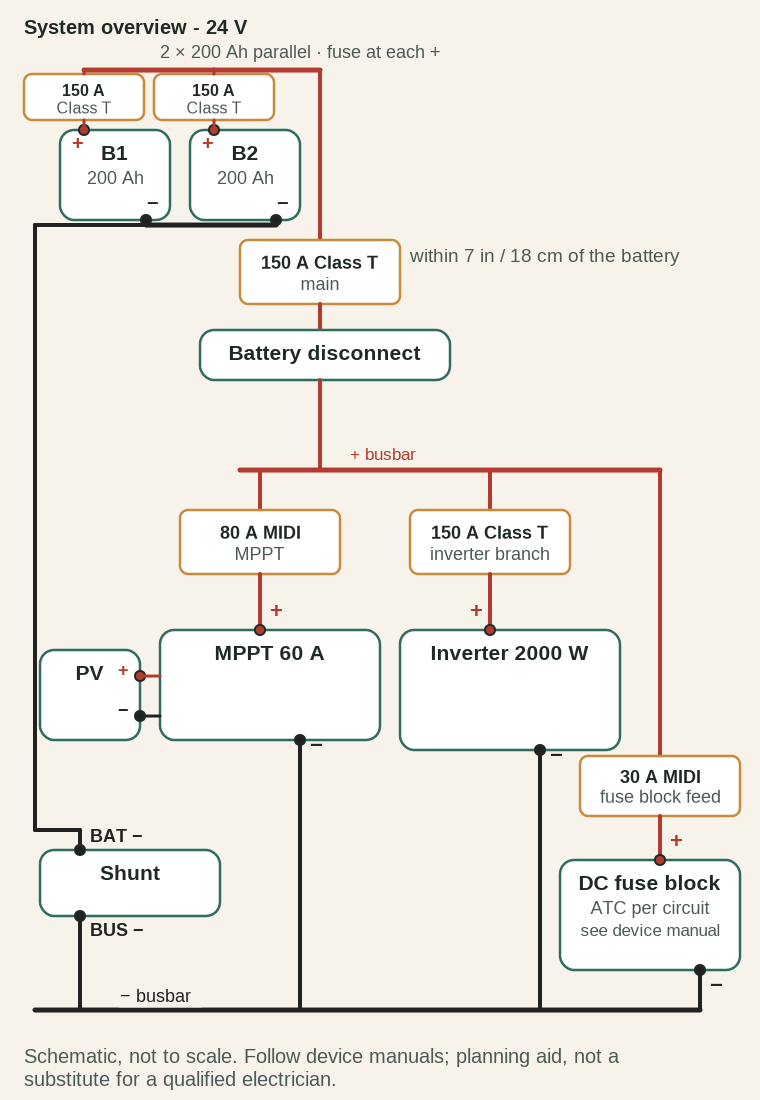
System overview of the 24 V plan: the two-battery parallel bank, the 150 A Class T main fuse, the 150 A Class T inverter branch fuse, the MPPT, the power inverter and the DC fuse block.
The current and fuse numbers are reproducible in the 12 V wire size calculator and the DC fuse size calculator, and the fuse roles there match the diagram.
What about a smaller 12 V air conditioner?
A 12 V DC air conditioner changes the plan in a useful way, because it skips the inverter and its conversion loss. A 900 W unit running 4 hours needs 3600 Wh per day, which the calculator covers with a 400 Ah bank, a 70 A MPPT and an 800 W array built as four 200 W panels. On a large van roof the calculator requires 760.6 W and doesn’t have to cap the array, and the Denver summer harvest is 3786.48 Wh against 3600 Wh of use.
That reserve is only a small cushion, so a run of cloudy days still drains the bank. At full load the 12 V bank discharges 107.47 A, so the BMS, or the sum of the two batteries’ BMS ratings in the parallel bank, has to support that continuous current. The 12 V plan also needs a 150 A Class T battery main fuse, and each battery in its parallel bank gets its own 150 A Class T fuse. The MPPT charge current is 55.56 A and the calculator requires a 69.44 A controller, rounded to a 70 A unit. That 70 A times 1.25 gives 87.5 A, which sets a 100 A MIDI charge fuse over 4 AWG cable. It is the friendlier plan when the roof is the limit, and it is still not a winter plan.
Can solar alone run an RV air conditioner?
Not in winter, and not on a cloudy summer run either. The Denver summer shortfall is 1756.46 Wh, and London summer leaves 3669.14 Wh that the panels never replace. On a London winter run the 60 A DC-DC charger adds 2457.6 Wh per day, which covers 33.05 percent of the daily load, and it needs an 80 A MIDI fuse on its branch with 6 AWG cable. The rest has to come from shore power or a generator, and the AC inlet, breaker and cable are electrician work, so hire a licensed electrician for that side of the system. It is worth reading the safety notes before you plan the AC inlet.
Which gear fits this plan?
The gear list shows the same plan as shopping categories, with the OhMyVan web tag applied. Start with the battery and the panels, then match the controller and the inverter, and keep each fuse and cable in the role it has in the calculator.
- 2 × 200 Ah 24 V LiFePO4 battery
- 6 × 200 W solar panels
- 60 A MPPT charge controller
- 2000 W 24 V pure sine inverter
- 150 A Class T fuse
- 2 AWG battery cable
- 60 A DC-DC charger
If your inverter or fuse holder manual asks for a larger fuse or cable than the calculator returns, the manual wins, and the cable has to be rated for that larger fuse. Two sibling guides go deeper on the same wiring: how many solar panels to run a fridge in a van and what size wire for a 2000W inverter in a van. The MPPT controller guide covers the controller choice, and the Solar category hub and the OhMyVan blog hold the rest.
Frequently asked questions
How many solar panels does it take to run an RV air conditioner?
The calculator needs 1571.1 W in a Denver summer and 4330.79 W in a Denver winter, but a large RV roof caps the array at 1200 W, so six 200 W panels are the most the roof takes. That array still leaves a 1756.46 Wh summer shortfall.
Will a 2000 W inverter start an RV air conditioner?
The calculator recommends a 2000 W continuous inverter for a 1500 W air conditioner, but the same run shows a 3000 W compressor surge. Match the inverter’s surge rating to that number, or have a qualified electrician fit a soft start on the 120 V AC side, and don’t assume the continuous rating covers the start.
How long can a 400 Ah battery run an RV air conditioner?
A 400 Ah 24 V bank gives 8192 Wh of usable energy, and the calculator puts the DC-equivalent daily load at 7436.18 Wh, which is 1.01 days of autonomy at that use. The air conditioner alone covers 6000 Wh of that total, so less cooling stretches the time.
How many amps does an RV air conditioner draw from a 24 V battery?
The 2000 W inverter’s maximum DC current is 108.225 A at the calculator’s 21 V design voltage, and the 1500 W load draws less than that; the battery bank’s continuous discharge is 110.10 A once the DC loads are added. The compressor surge is higher for a moment. The battery BMS, or the sum of the BMS ratings in a parallel bank, has to support both the 108.225 A inverter branch current and the 110.10 A total discharge.
What size fuse does the inverter branch need for an RV air conditioner?
The inverter branch takes a 150 A Class T fuse at the positive busbar. The cable that carries it is 2 AWG, and every size below that in the ABYC table falls short of the ampacity the fuse needs with the design reserve. The battery main fuse is a separate 150 A Class T within 7 in / 18 cm of the battery.